Telecom BusinessCesiumastroSynchronicitySatellite CommunicationsPhased Arrays
CesiumAstro Raises $730M Series D at $4.5B Valuation
CesiumAstro's $730M Series D at a $4.5B valuation funds a 737-satellite Synchronicity constellation across Ku, Ka and V bands, marking its pivot to operator.
 Telecom Business
Why it matters
- CesiumAstro raised $730M in Series D funding at a valuation above $4.5 billion, announced Nov. 5, 2026
- $630M equity led by Janus Henderson; $100M debt from J.P. Morgan and EXIM
- Funds a planned 737-satellite Synchronicity constellation across Ku, Ka and V bands
- Builds on an earlier $470M EXIM-backed milestone for a Texas phased-array manufacturing complex
- Element-1 precursor satellite launched in October to validate the RF payload architecture
The story
CesiumAstro has closed a $730 million Series D round at a valuation exceeding $4.5 billion, financing the Austin-based phased-array developer's transition from component supplier to commercial constellation operator.
The round, announced Thursday, Nov. 5, 2026, splits into $630 million in equity led by asset manager Janus Henderson and $100 million in debt financing from J.P. Morgan and the Export-Import Bank of the United States (EXIM). At roughly $4.5 billion post-money, the deal values the company at more than six times the $470 million earlier funding milestone that EXIM backed through its "Make More in America" initiative — a facility that funded a dedicated phased-array manufacturing complex in Texas.
What changes for CesiumAstro?
Until now, CesiumAstro's business has been supplying communications payloads to other operators' satellites. The Series D capital bankrolls a strategic pivot: building and running its own orbital network. Proceeds will pay for the physical buildout and mass-production lines needed to support end-to-end flight vehicle integration — a considerably heavier capital burden than payload contracting, and one reason debt from J.P. Morgan and EXIM now sits alongside equity on the balance sheet.
The company says the Series D will accelerate payload manufacturing, regulatory filings and constellation assembly at its Austin production complex. The announcement did not specify launch dates, launch providers or the total projected cost of the constellation — figures investors in comparable ventures typically disclose at this stage.
What is Synchronicity?
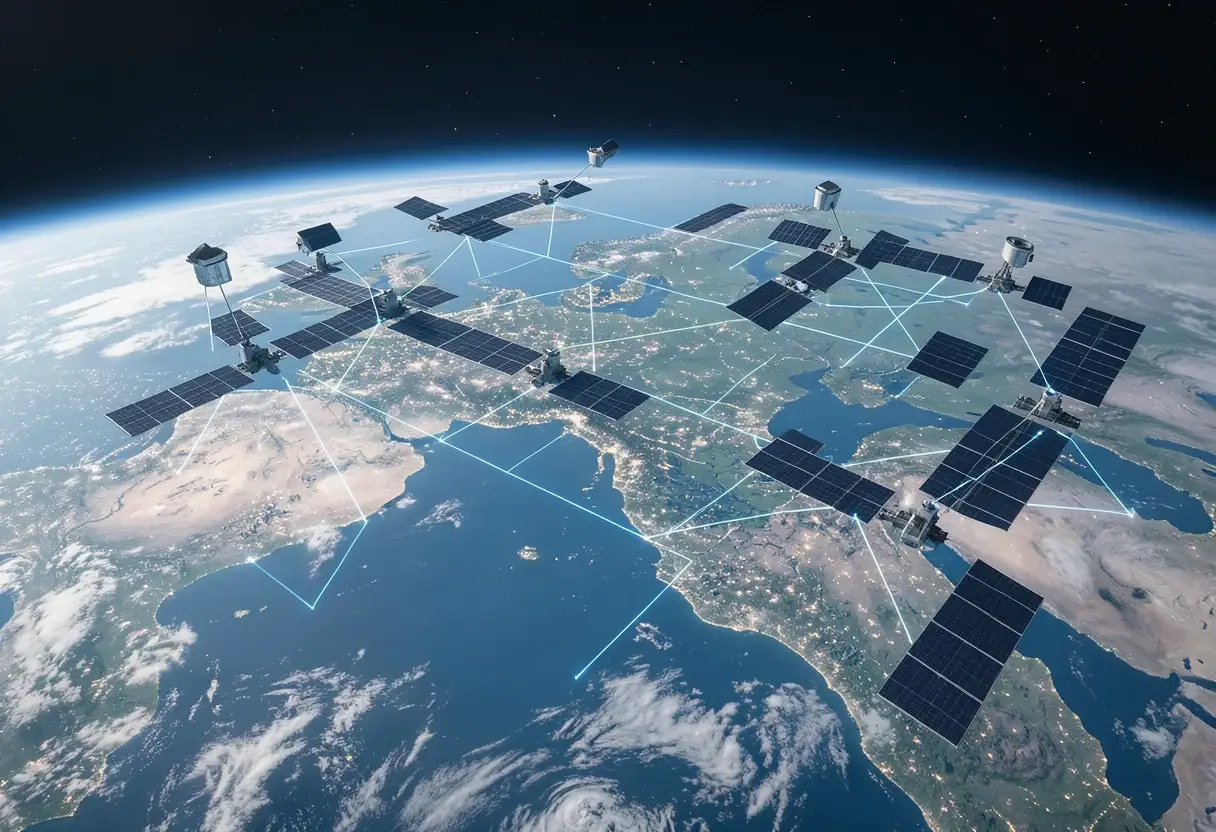
The funding directly supports Synchronicity, a planned 737-satellite constellation intended to serve commercial, sovereign and defense users with flexible communications. Two architectural claims anchor the design:
- Multi-band coverage: the network will operate across Ku-band, Ka-band and V-band spectrum, supporting high-throughput terrestrial links and inter-satellite connections.
- Autonomous resource allocation: onboard artificial intelligence is slated to route beams dynamically and allocate bandwidth in real time according to active network demand.
Both capabilities rest on claims not yet demonstrated at constellation scale. Onboard AI-driven beam routing in orbit remains largely unproven commercially, and V-band operation — prized for its bandwidth — carries atmospheric attenuation and interference risks that earlier systems have struggled to manage. The company has, however, taken a first validation step: its Element-1 precursor satellite launched in October to test the core radio frequency payload and processing architecture in orbit. No results from that mission appear in the announcement.
The Synchronicity architecture extends the company's Element satellite platform, which CesiumAstro positions as the technical foundation for the full network.
What happens next?
With the round closed, CesiumAstro says flight hardware deliveries and orbital launches for the Synchronicity network will follow — though the announcement, as released, cuts off before specifying timing, leaving the deployment schedule and regulatory pathway undefined. A 737-satellite build would place the constellation among the larger commercial programs announced to date, and mass production in Austin will determine whether the $730 million covers assembly alone or requires further raises.
Also reported
Source: satnews.com
More from Rebecca Stone
Show full bio
Correspondent covering technology and product news in Carrier business, 5G and 6G, fiber and broadband at Telecom Gazette.
459 articles