Networks & InfrastructureNvidiaLambdaCo Packaged OpticsAI Infrastructure
Lambda reports up to 15x reliability from Nvidia CPO switches
Lambda says Nvidia CPO switches connect more than 10,000 Blackwell Ultra GPUs at its 142MW Quebec campus, running cooler and claiming up to 15-times higher reliability.
 Networks & Infrastructure
Why it matters
- Lambda's Nvidia CPO deployment spans 10,000-plus Blackwell Ultra GPUs at its 142MW Quebec campus.
- Lambda disclosed last November that it was trialing the InfiniBand-based Quantum-X Q3450-LD switch.
- Each Quantum-X Q3450-LD switch has a 4U form factor, 144 800G ports and 18 removable external light sources.
- Lambda reports a 36°C median temperature versus 51°C for conventional optics, with up to 15-times higher reliability.
- Nvidia plans roughly fifteen-fold optics manufacturing expansion to meet anticipated demand.
The story
By Elena Vasquez
Lambda says switches using Nvidia’s co-packaged optics now connect more than 10,000 Blackwell Ultra GPUs at its 142-megawatt campus in Quebec, Canada, with up to 15-times higher reliability than conventional optics.
What does the Quebec deployment show?
The deployment extends beyond the trial stage. Lambda says the photonic switches are now fully used to connect tens of thousands of Blackwell Ultra GPUs, after it revealed last November that it was trialing Nvidia’s InfiniBand-based Quantum-X Q3450-LD switch.
Lambda was among the companies given initial access to Nvidia’s photonic technology. Its November disclosure therefore predates the larger operating deployment now described at the Quebec site. The update does not identify any other trial participants or publish a schedule for the earlier phase.
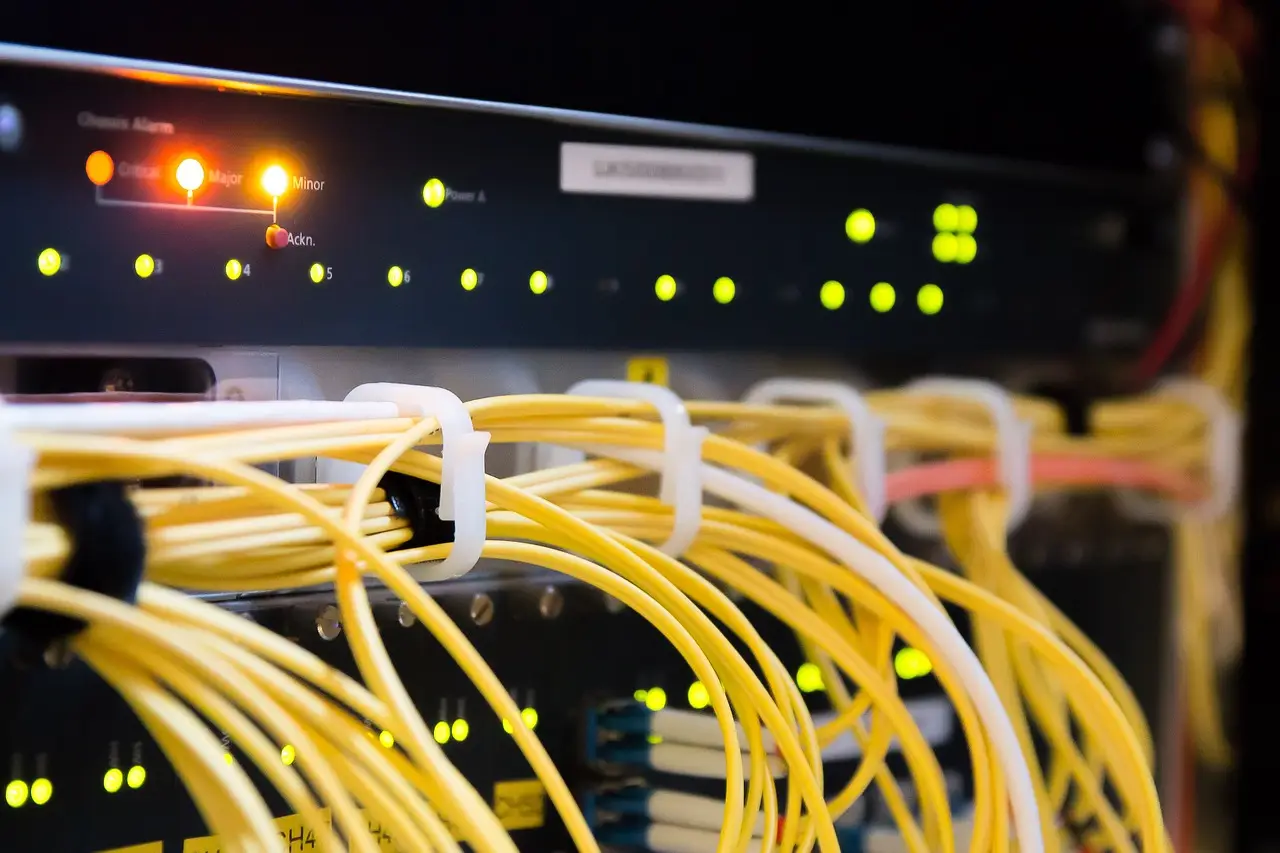
Each switch uses a four-unit (4U) chassis and carries 144 800Gb/s (800G) ports. Eighteen removable external light sources support the co-packaged optical interconnect.
For Lambda, the commercial step is from early component access to full deployment at a site sized for 142MW. The update does not disclose the installed switch count, leaving the network’s full port capacity unquantified.
Lambda’s reported operating result is a lower median temperature of 36°C, compared with 51°C for conventional optics. The neocloud says the cooler optics provide up to 15-times higher reliability. Lambda also reports identical throughput and more stable signal integrity, with lower latency gaps as the network scaled up.
These figures come from Lambda, not an independent laboratory test. The update provides no baseline failure rate, observation period, workload description or measurement method. Accordingly, the 15-times figure remains a relative operator claim, while the two temperatures describe the reported deployment.
What does the reliability claim establish?\n
Dave Ward, Lambda’s president of cloud services, tied the deployment to the scaling of AI clusters. He said: “Networking has to keep pace with the demands of increasingly large AI clusters. Bringing co-packaged optics into a deployment of this scale is an important step toward building the efficient and resilient infrastructure needed to support the next generation of AI.”
Ward’s wording links CPO to resilience and operating efficiency rather than a standalone bandwidth upgrade. Lambda says the photonic interconnect delivers identical throughput, so its case rests on cooler operation, stronger signal stability and the claimed reliability improvement as the network scales.
Before Jensen Huang’s abrupt departure as Nvidia’s chief executive, the chipmaker had been counting on CPO to drive growth in an already strong networking business. While chief executive, Huang said optical-interconnect switch sales would reach several orders of magnitude above Nvidia’s present shipments. That was a demand forecast, not a disclosed contract or revenue result.
Nvidia has recently unveiled plans to increase optics manufacturing capacity by roughly fifteen-fold to meet anticipated demand. Huang told SDxCentral that scale-up networking alone would be a key driver. The announcement gives no completion date, capital-spending figure or supply agreement tied to Lambda’s installation.
How does Nvidia frame the commercial case?
Gilad Shainer, Nvidia’s senior vice president for networking, responded to Lambda’s update with the commercial argument: “In an AI factory, the network is a business accelerator. Every interruption stalls the job, and every watt counts.”
He added: “Nvidia Photonics cuts network power, improves resiliency, and delivers up to 15-times higher reliability, so Lambda’s customers get more productive GPU hours from their investment.”
That is Nvidia’s product claim, and it translates Lambda’s reported temperature figures into lower power use and more productive GPU time. No wattage saving or GPU-hour gain is disclosed.
The platform context is Nvidia’s InfiniBand-based Quantum-X family, which Lambda trialed before the larger deployment. The reported gains therefore apply to a defined switching platform, rather than every data-center network.
The commercial test is now whether Nvidia can turn its planned fifteen-fold capacity increase into manufacturing output and broader switch sales. Lambda has established a large-site use case, but neither company provides a timetable for wider deployment or additional customer installations.
Also reported
Source: sdxcentral.com
More from Elena Vasquez
Show full bio
Market editor covering companies, deals and strategy in Carrier business, 5G and 6G, fiber and broadband at Telecom Gazette.
523 articles