Networks & InfrastructureAI InfrastructureLiquid CoolingData CentersGpu Computing
India's NSE deploys direct-to-chip liquid cooling for AI push
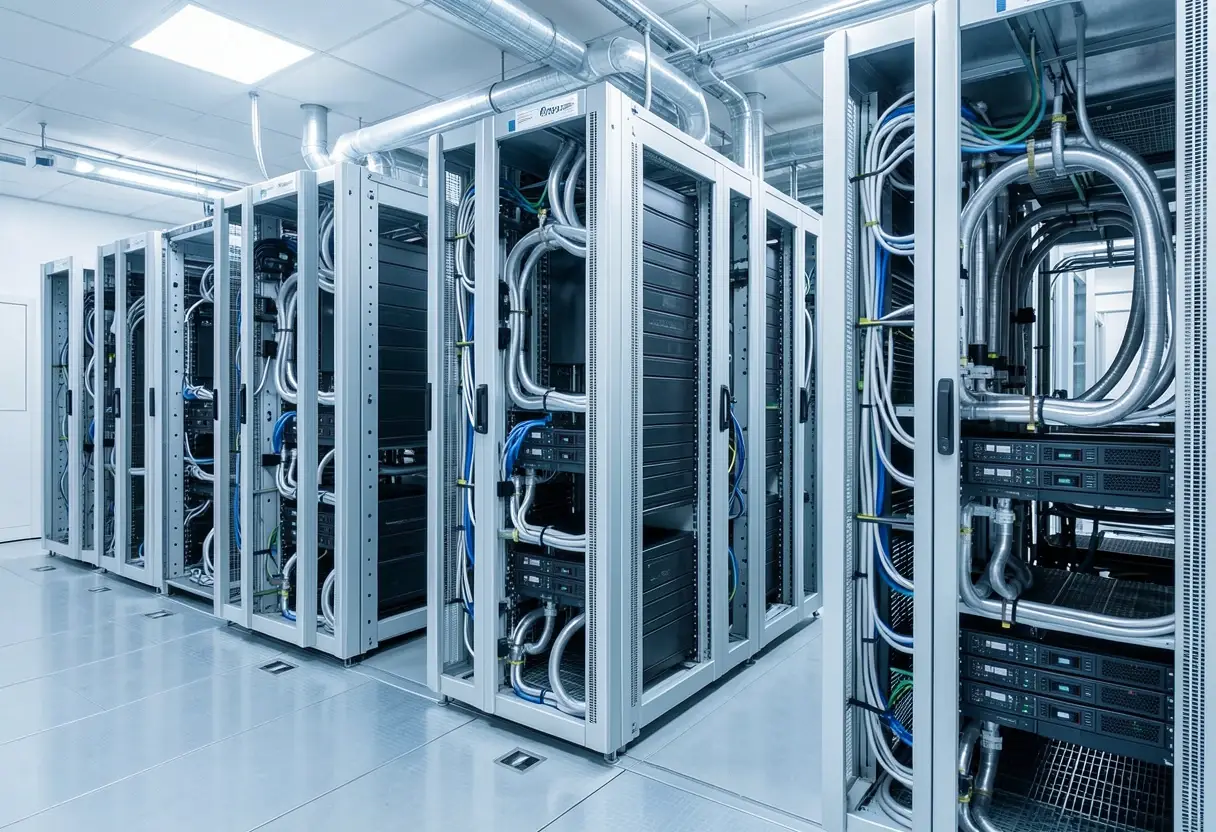
NSE has deployed direct-to-chip liquid cooling on-premises, targeting 80 GPUs this quarter and 224 across high-density racks as it converts its HQ into a data center.
 Networks & Infrastructure
Why it matters
- NSE deployed direct-to-chip liquid cooling at its on-premises data center.
- Up to 80 GPUs planned this quarter, expanding to 224 GPUs in high-density racks.
- NSE is converting its Exchange Plaza headquarters into a large data center, with a three-year timeline revealed in 2025.
- In 2024 NSE planned to triple its Mumbai colocation data center capacity to 4,000 racks.
- DLC may later extend to NSE's colocation facility depending on customer requirements.
The story
India's National Stock Exchange (NSE) has deployed direct-to-chip liquid cooling (DLC) at its on-premises data center to support an AI infrastructure build-out that will reach 80 GPUs this quarter and up to 224 GPUs across high-density racks.
The exchange has not disclosed which GPU models it is installing. What it has made clear is the shape of the ambition: a dense, liquid-cooled compute layer inside its own facility rather than in a public cloud.
Why keep it on-premises?
The decision to run the deployment in-house is about control. NSE wants to retain authority over its data, computing resources and access, a posture it says strengthens data sovereignty and security governance under applicable regulations.
For a market operator that sits at the center of India's capital markets, that logic is straightforward. Trading infrastructure carries regulatory obligations that make wholesale outsourcing of compute unattractive, and AI workloads raise the stakes on both data handling and resilience.
The exchange also sees this as a beginning rather than an endpoint. It plans to extend direct-to-chip cooling to its colocation data center as well, depending on what customers require.
What is the exchange saying?
Sampath Manickam, CTO of NSE, framed the deployment as preparation for demand that has not fully arrived yet.
"AI is driving a fundamental shift in technology infrastructure, with significantly higher demands on compute density, power, and cooling. At NSE, our approach is to anticipate these requirements and build ahead of demand," Manickam said.
"The DLC deployment provides a scalable and energy-efficient foundation for high-density GPU computing and strengthens our readiness for the next generation of AI workloads. As we expand these capabilities, our focus will remain on building resilient, scalable and future-ready infrastructure that supports NSE's evolving technology needs and the continued growth of India's capital markets."
A building becomes a data center
The cooling deployment sits inside a wider real estate and infrastructure overhaul. NSE is moving out of its Exchange Plaza headquarters, the building that houses critical operations and the IT division, and converting the entire structure into a large data center.
The exchange's new headquarters will occupy G Block of the Bandra Kurla Complex, Mumbai's secondary financial district. According to a report from the Economic Times, the plan was revealed in 2025 and carries a three-year completion timeline.
That is not NSE's only facility project. The exchange's data center ambitions have been visible for several years:
- In 2022, NSE announced it would build an "exclusive data center" on the outskirts of Mumbai for colocation customers.
- In 2024, it disclosed plans to triple that facility's capacity to 4,000 racks.
Why liquid cooling matters here
Direct-to-chip cooling moves liquid directly to the processor package instead of pushing air across racks. The technique matters at GPU densities like the ones NSE is planning, where air cooling struggles to carry away the heat that hundreds of accelerators generate.
Energy efficiency is part of the pitch, and Manickam's reference to it echoes vendor messaging across the cooling sector. The harder commercial fact is capacity: high-density racks packed with GPUs are simply not practical without some form of liquid cooling, so the deployment is less a differentiator than a prerequisite.
The expansion path is the part to watch. If the 80 GPUs land this quarter as planned and the build-out reaches 224, extending DLC into the colocation facility would follow a documented timeline anchored to customer demand rather than a fixed date.
Also reported
Source: datacenterdynamics.com
More from Elena Vasquez
Show full bio
Market editor covering companies, deals and strategy in Carrier business, 5G and 6G, fiber and broadband at Telecom Gazette.
513 articles