Networks & InfrastructureAst SpacemobileBlacklift RocketBluebird SatellitesSatellite Launch
AST SpaceMobile Puts $1.3 Billion Behind Its Own Blacklift Rocket
AST SpaceMobile will invest $1.3 billion in its own Blacklift rocket, targeting a 2028 debut, as Q3 revenue tripled to $42.3 million while net loss hit $132.4 million.
 Networks & Infrastructure
Why it matters
- AST SpaceMobile is investing $1.3 billion (€1.1 billion) in its own Blacklift rocket, targeting a first launch in 2028 from Wallops, Virginia.
- Blacklift is designed to carry five Bluebird satellites per launch, with 20 metric tons of lift capacity, a reusable first stage and twice-monthly cadence.
- Q3 2026 revenue was $42.3 million, up 187 per cent year on year, with a net loss of $132.4 million.
- First nine months of 2026: revenue of $88.6 million, up about 433 per cent, against a net loss of $554.3 million.
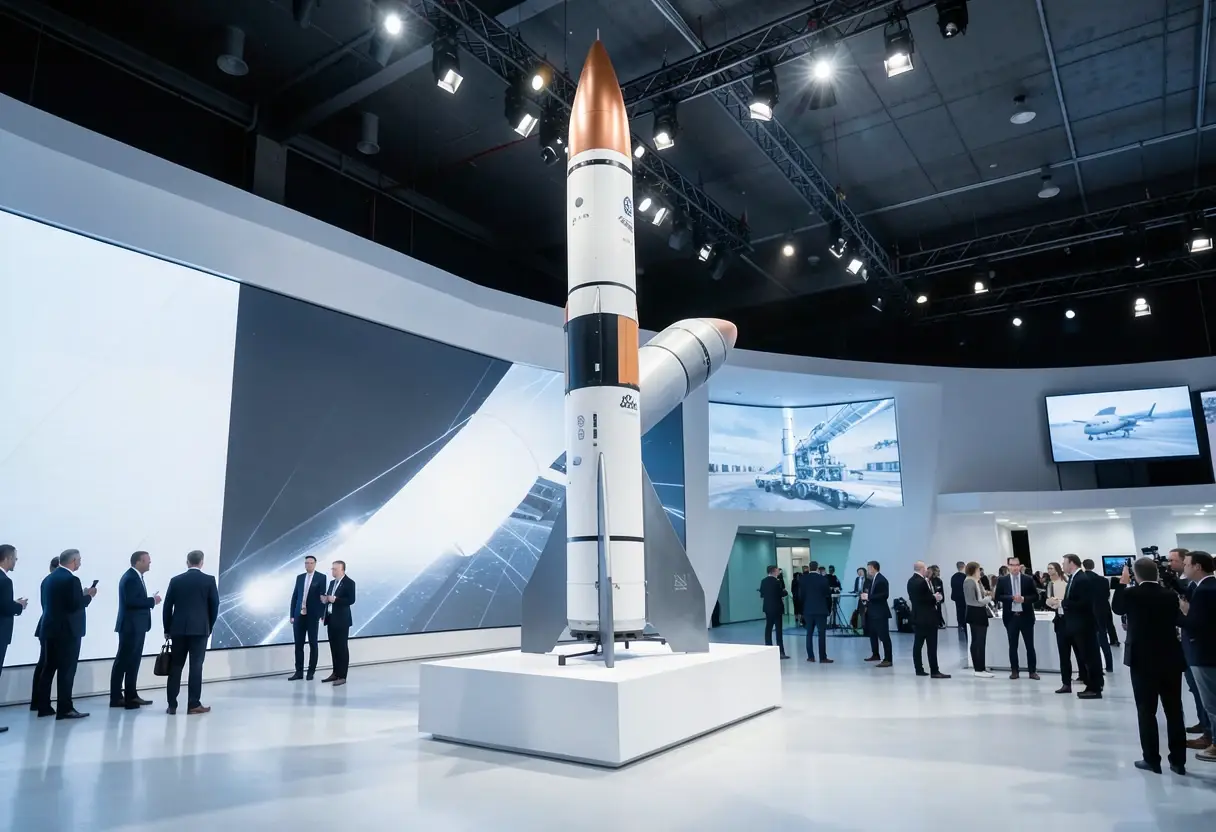
- The rocket displayed at the November 12 New York event was a dummy; engines have been procured, per CEO Abel Avellan.
The story
AST SpaceMobile told investors in New York on November 12 that it will spend $1.3 billion (€1.1 billion) building its own rocket, with CEO Abel Avellan claiming the vehicle — displayed at the event as a giant dummy — could be ready within two years and launch for the first time in 2028.
The satellite-direct-to-smartphone operator presented the Blacklift rocket alongside its Q3 2026 results. Avellan framed the move as a response to a severe shortage of launch capacity for the company's Bluebird satellites, not an ambition to compete with established launch providers.
What did Avellan actually promise?
The numbers behind the promise are large. Blacklift is designed to carry five Bluebird satellites into low-Earth orbit per mission, with 20 metric tons of lift capacity, a reusable first stage, three stages in total, and all-composite tanks. AST targets two launches per month from a pad at Wallops Flight Facility in Virginia.
Avellan argued the design can be simpler than a general-purpose rocket because it serves one purpose: lifting AST's own satellites. He paraphrased SpaceX founder Elon Musk several times during the presentation, repeating the line that "the best part is no part."
"We're not doing this thing because we like rockets," Avellan said. "We're not doing this thing because we want to be in the launch business. We want this because we have so much demand of our satellites, and as you have seen it, we cannot get enough launches."
He also claimed AST has already procured engines for Blacklift, and asserted that engine development typically accounts for 80 per cent of a rocket's development cycle — implying the hardest part is, in his telling, already solved.
"Of course rocket engineers are going to get mad with me, but you can simplify it as a big tank feeding engines," he said. "So big tanks — we know how to do them. We know how to do them. We know how to do them in composite."
The caveats write themselves. The rocket shown in New York was a dummy. No engine test, static fire, or pad infrastructure milestone was reported. A company that has never built a launcher promising a reusable, three-stage, twice-monthly cadence by 2028 invites comparison with launch programs at established operators that took far longer to reach routine flight — the 2028 date is a target, not a demonstrated schedule. Avellan's 80 per cent engine-development claim is his own estimate, presented without supporting engineering detail.
What do the Q3 numbers show?
The financial results reveal a company still in the earliest phase of commercial service, barely serving its telco partners or consumers, yet burning cash at a rate that makes the rocket decision consequential.
- Revenue: $42.3 million, up 187 per cent year on year — roughly triple the year-ago figure.
- Product revenue: $20.6 million; services revenue: $21.8 million, split almost evenly.
- Operating expenses: $211 million, roughly five times quarterly revenue.
- Net loss: $132.4 million, more than three times the quarter's entire revenue.
For the first nine months of 2026, revenue reached $88.6 million, up approximately 433 per cent year on year, while the net loss widened to $554.3 million. Put another way: AST lost more than $6 for every $1 of revenue it booked over that period. The 433 per cent growth rate reflects a low base rather than scale — nine-month revenue of $88.6 million is small against a $1.3 billion rocket commitment, which alone equals nearly 15 times the company's revenue for the period.
Why build rockets at all?
The stated logic is scarcity. AST needs frequent, heavy-lift launches to deploy its Bluebird constellation fast enough to serve mobile operators' subscribers, and third-party launch capacity has not kept pace with its demand. Vertical integration into launch is a bet that building its own rockets is cheaper or faster than waiting in other providers' queues — a claim that only flight history will test.
The company is asking investors to fund two races at once: scaling a satellite service that is only now generating meaningful revenue, and entering the launch business it insists it does not want to be in. Avellan's 2028 target gives the market a concrete date to hold him to; whether the tanks, engines and the Wallops pad come together on that timeline will determine whether Blacklift solves AST's launch bottleneck or becomes its second capital-hungry development program.
Also reported
Source: Advanced Television
More from Rebecca Stone
Show full bio
Correspondent covering technology and product news in Carrier business, 5G and 6G, fiber and broadband at Telecom Gazette.
508 articles